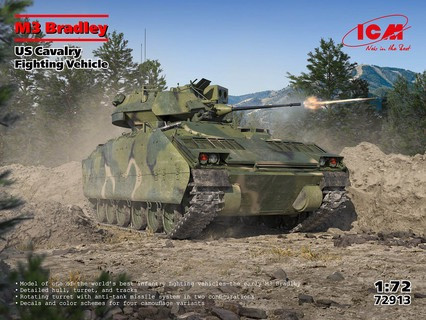
While developing a combat vehicle for mechanised infantry units under the MICV (Mechanised Infantry Combat Vehicle) program, the United States also developed an armoured reconnaissance vehicle under the ARSV (Armoured Reconnaissance Scout Vehicle) program. In spring 1977, both programs merged into FVS (Fighting Vehicle Systems), creating the unified Bradley Fighting Vehicle platform. The concept included two variants: the M2 Bradley infantry fighting vehicle and the M3 Bradley cavalry fighting vehicle, crewed by three soldiers plus two scouts. The M3 Bradley retained the same primary armament as the IFV* but carried more ammunition—1,500 rounds for the automatic cannon, 4,300 rounds for the machine gun, and 10 TOW anti-tank missiles for heavy armoured targets. Equipment included a portable ground surveillance radar, specialized radios, night vision devices, and space in the modified troop compartment for a motorcycle. The M3 Bradley later underwent upgrades to enhance protection and improve firepower.
Model Features
Model of one of the world's best infantry fighting vehicles - the early M3 Bradley
Detailed hull, turret, and tracks
Rotating turret with anti-tank missile system in two configurations
Decals and colour schemes for four camouflage variants
Markings Available
M3 Bradley, 2nd Squadron, 6th Cavalry Regiment, Fort Knox, Kentucky (U. S. Army Training Centre, Armour), January 1983
M3 Bradley, 3rd Infantry Division, West Germany, mid-1980s
M3 Bradley, 1st Cavalry Regiment, 5th Infantry Division (Mechanised). Fort Polk, Louisiana, April 1990